
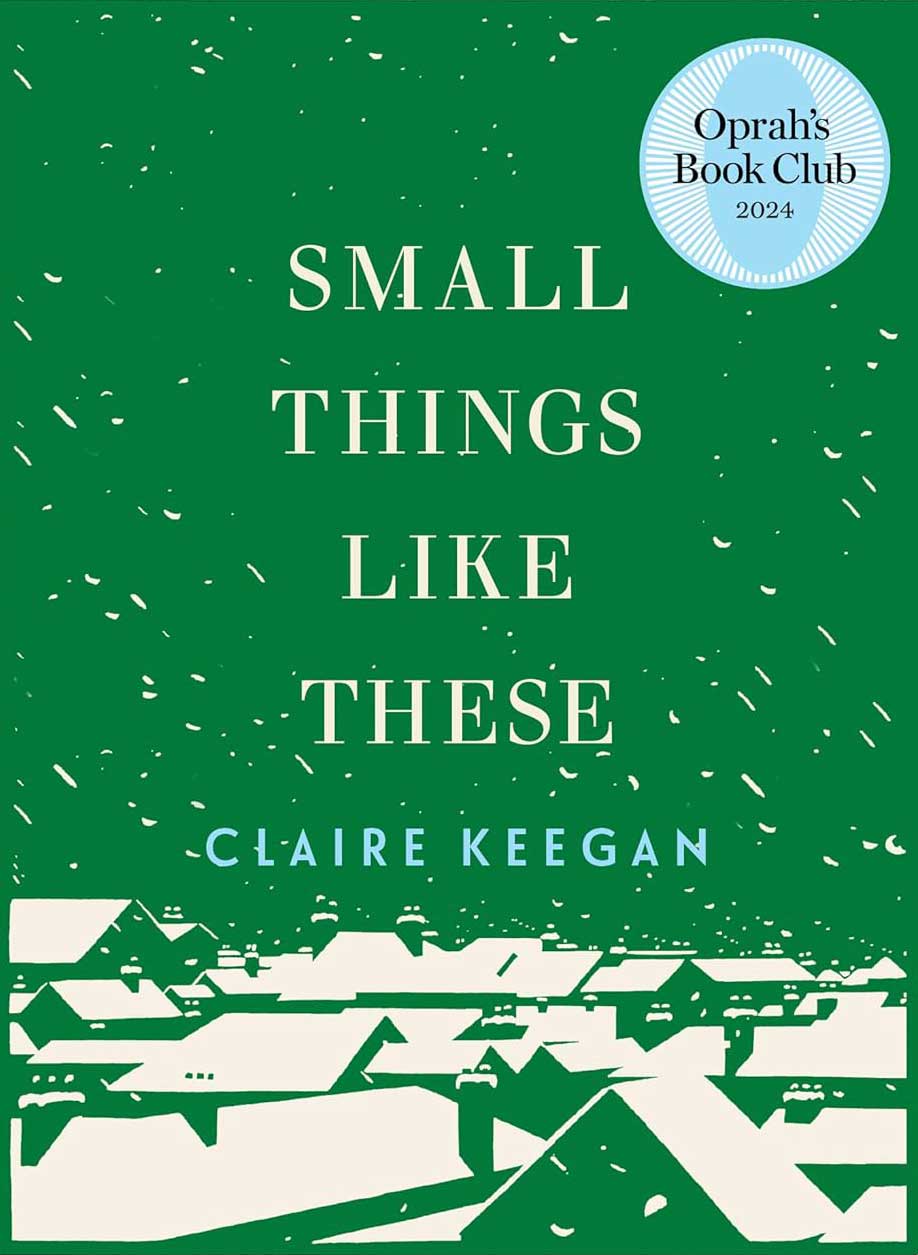
I love ritual—in the classroom and in life. And even more so when ritual involves literature. If you’re reading this on a chilly New York December day, I invite you to join me in one of mine: reading Claire Keegan’s Small Things Like These in a cozy sitting or two.
This is my fourth year reading Keegan’s novella during December. Set in 1980s small-town Ireland at Christmastime, Keegan’s novella asks an ordinary coal merchant and his family to reckon with the notorious Magdalen laundries. What follows is subtle but sure, the kind of story that slowly demands compassion, courage, and hope from its reader.
With each read, I’m struck by how the text sanctifies our ordinary living. How much Keegan’s sinewy prose holds in its grasp. How the main character, Bill Furlong, slowly transforms through infinitesimal decisions and shifts in attention until all of a sudden it accumulates into no small thing. Furlong’s character attests to the boldness possible against the complicit inertia of life’s monotony—especially if that monotony averts our gaze from cruelty, numbing our sensitivities to what is right, just, or true.
Winner of the Orwell Prize for Political Fiction and shortlisted for the Booker Prize in 2022, Thuy Dinh, for NPR, called Small Things Like These a “feminist revision of Charles Dickens’ A Christmas Carol.” It’s not for these accolades that I keep returning to it, December after December.
I hope you’ll brew a cup of tea and carve out a few hours to join me this month. Happy reading!
Meg Davis Roberts is an Assistant Professor of Adolescence English Education at SUNY New Paltz where she also works with the Hudson Valley Writing Project and serves on the English Language Arts Teacher Educators (ELATE) Commission on the Teaching of Poetry. She began her teaching career in 2015—teaching middle and high school English Language Arts in the Chicagoland area and East Jerusalem—and is a National Board Certified Teacher (NBCT). She received her doctorate in English Education from Teachers College Columbia University under the advisement of Ruth Vinz; at TC, she was the Enid & Lester Morse Fellow for new teachers..